Climb Mount Nantai Through the Night
For one week every summer, you can do something you can’t do at any other time of year: climb Nikko’s sacred volcano in the dark, under the stars, and watch the sun rise from the summit.
Mount Nantai is closed to climbing at night for all but this single week. During the Nantaisan Tohai Kosha Taisai — the mountain-opening festival of Futarasan Shrine — the trailhead gate opens at midnight, and pilgrims set off up the mountain in the dark. It’s a tradition that has been kept for over 1,200 years, since the late Nara period, making this one of the oldest continuously observed climbs in Japan.
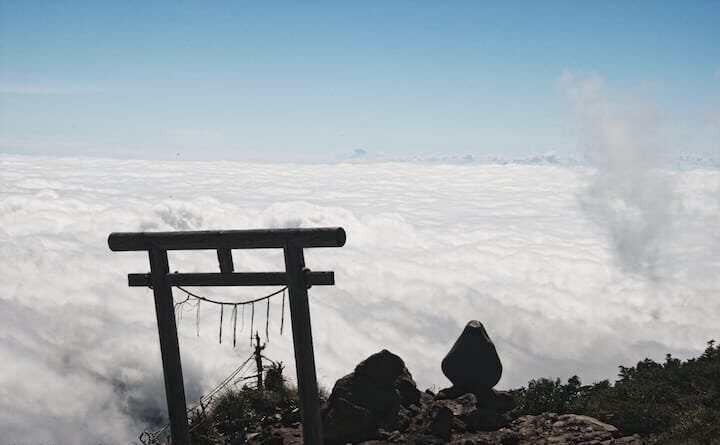
What the Climb Is Like
This is a serious mountain. From the shrine on the shore of Lake Chuzenji, the trail gains roughly 1,200 metres to the 2,486 m summit in one relentless push — first through forest, then up a steep field of reddish volcanic rock, with the lights of Chuzenji shrinking below you and the whole sky open overhead. Climbing it by headlamp, in a slow line of lanterns, is unlike any day hike.
You’ll reach the crater rim and the inner shrine (Okumiya) before dawn. As the light comes up, Lake Chuzenji appears far below, Senjogahara stretches out beyond it, and on the clearest mornings Mount Fuji floats on the horizon. The sea of clouds catching the first sun is the reason people have made this climb for twelve centuries.
For the full route, terrain, and what to pack, see our complete Mount Nantai hiking guide.
When It Happens
The Mount Nantai Climbing Festival runs the same dates every year, July 31 to August 7, regardless of the day of the week. Night climbing is only possible during this window. Most climbers start in the small hours to reach the summit around 4:30–5:00 a.m. for sunrise.
What You Need to Know
- This is a strenuous, sacred climb, not a casual walk. Good fitness, proper footwear, and a headlamp are essential. It is not suitable for young children.
- A ¥1,000 entry fee per person is required at the Futarasan Shrine gate before you start (cash). It’s mandatory to enter the trail.
- Carry your own water — there are no reliable water sources on the trail above the shrine. At least 2 litres per person.
- Dress for the summit, not the lakeshore. It is cold and exposed at 2,486 m before dawn, even in August. Bring layers and a windproof.
- Bring a bear bell and basic mountain sense — this is a wild mountain in a national park.
Stay at Earth Hostel Nikko Riverhouse
A midnight climb is far easier with a real base nearby. Earth Hostel Nikko Riverhouse is a riverside hostel in the mountains south of Nikko, with no curfew — so a pre-dawn start is no problem — and a free shuttle to Nikko Station, where you connect by bus toward Lake Chuzenji and the trailhead. This is a self-guided climb: you go at your own pace with the other pilgrims on the mountain, not as part of a hostel tour. What we offer is the base — a bed with no curfew, somewhere to leave your things, and a place to come back to afterwards to sleep, swim in the Kurokawa, and recover by the river. We’re open spring to late autumn, right through the festival week.
Planning the timing around the late buses and the shuttle takes a little thought — get in touch and we’re glad to help you work it out.