Shodo Shonin was the Buddhist monk traditionally credited with founding Nikko more than 1,200 years ago. Before he opened Nikko’s great temples, local legend says he trained beside a pond near Okorogawa and washed his robes there until the water ran black, giving the Black River its name. That same river runs past Earth Hostel today.
Shodo Shonin and the Legend of Nikko’s Black River
Who was Shodo Shonin?
Shodo Shonin — properly Shōdō Shōnin (勝道上人), 735–817 — was a Buddhist monk of the Nara and early Heian periods, remembered as the founder of Nikko, the man who first opened its mountains to Buddhist practice. He is the figure behind the temples and shrines that later made Nikko famous, and his bronze statue still stands near the Shinkyo Bridge at the entrance to the old sacred precinct. But long before any of that, his story begins much closer to home: in the quiet valley of Okorogawa, on the river that runs past Earth Hostel.
Training at Keimeizan, above Okorogawa
In the years before he climbed Nikko’s great peaks, Shodo Shonin is said to have trained on Keimeizan (鶏鳴山), a 962-metre mountain rising above the hidden hamlet of Okorogawa (小来川) in the south-east of present-day Nikko. Local tradition holds that he built a small hermitage beside a pond at the foot of the mountain and used it as his base, living the hard, solitary life of a mountain ascetic. It was, in effect, his training ground — the place where he sharpened the discipline that would later carry him up the far larger sacred peaks around Nikko.
The legend of the Black Pond
The legend that grew up around that pond is the reason this whole valley carries the word “black.” The story goes that Shodo Shonin bathed in the pond and washed his robes there every morning and evening, and that over time the water darkened — until the place came to be called Kuronuma (黒沼), the “black pond.” It is a tale that turns up again and again across local sources, which suggests it has long been the area’s main account of how the water came to look dark. Whether or not a pond ever truly ran black, the name stuck.
From Black Pond to Black River
There is a thread of local history beneath the legend. Older accounts describe how the black pond formed when the flow of the Kurokawa (黒川, Black River) was blocked near Yasaka Shrine, backing the river’s water up into a marsh. The river, in other words, is what filled the pond — so the same “black” name links the river and the marsh together, hydrology and folklore braided into one. Today the original pond survives as a quiet wetland of grassy tussocks, and a stone marker there was cut from part of Kurokawa Shrine’s torii gate, which collapsed in the 1949 Imaichi earthquake — a small, real monument rooting an old story to the ground.
The same river, at Earth Hostel
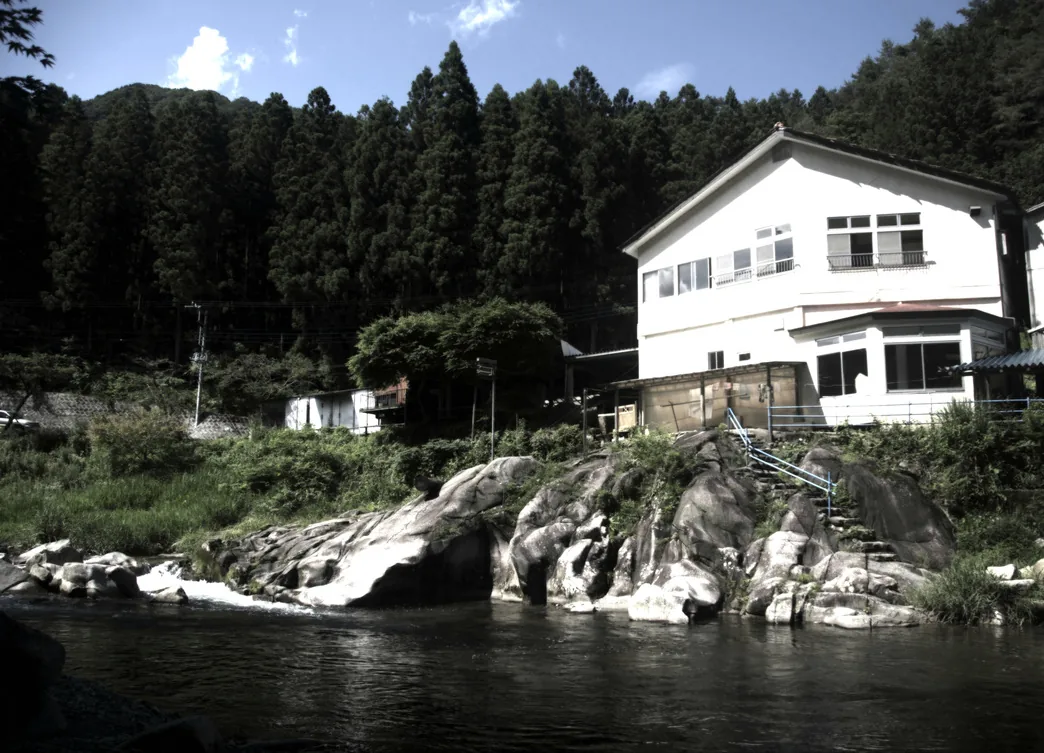
That river is the Kurokawa that still runs clear and fast past Earth Hostel, a little further down its course. The water legend once painted black is, in truth, some of the cleanest you will find — bright and new at its source in the Okorogawa highlands, gathering into the refreshing, swimmable stream guests step into on a hot summer afternoon. To stay here is to sleep beside the very river at the heart of Nikko’s founding story. If you would rather swim it than read about it, that is what the river-swimming page is for.
From Okorogawa to the founding of Nikko
Okorogawa was only the prologue. From his mountain training, Shodo Shonin went on to cross the Daiya River — the crossing remembered today by the red Shinkyo Bridge — and to found the temples and shrines that still define Nikko: Rinnoji, Futarasan Shrine, and the sacred sites around Lake Chuzenji. He is best remembered for the ascent of Mount Nantai, the volcano above the lake, which tradition says he finally climbed after years of trying. Seen this way, the hidden valley of Okorogawa is where the founder of Nikko first became the ascetic capable of all the rest — part of why this quiet river matters more than its size suggests. The mountains he trained in are still walkable; our Nikko hiking guide is a good place to start.
Shodo Shonin and the Black River: FAQ
Who was Shodo Shonin?
Shodo Shonin (735–817) was a Buddhist monk traditionally credited with founding Nikko, Japan. He opened the area to Buddhist practice and is associated with Rinnoji, Futarasan Shrine, and the first ascent of Mount Nantai.
Who founded Nikko?
By long tradition, Nikko was founded by the monk Shodo Shonin in the eighth century, when he established its first temples and shrines after years of mountain training above Okorogawa.
Why is it called the Black River?
Local legend says Shodo Shonin washed his robes in a pond fed by the river until the water ran black, giving the pond — Kuronuma, the “black pond” — and the Kurokawa (Black River) their name. It is folklore rather than documented fact, but the name has lasted.
Where is Okorogawa?
Okorogawa is a small mountain hamlet in the south-east of Nikko, Tochigi, near the source of the Kurokawa River. Earth Hostel sits downstream on the same river.
Can you visit the Black Pond?
The original pond survives as a quiet wetland near the foot of Keimeizan in Okorogawa, marked by a stone cut from a fallen shrine torii. It is an out-of-the-way local site rather than a major attraction — ask our staff for directions.
Stay on the Black River
There are few places where the water you swim in carries a twelve-hundred-year-old story. Stay at Earth Hostel and the Kurokawa is right outside your door — the same river, the same valley, a little further down the mountain.